

Your self-build begins with an idea of a home.
Imagine a ribbon of morning sunlight projecting across the kitchen table. A large space to gather and celebrate. A quiet corner to retreat to after a long day. A home that feels right for the way you live.
If you are wondering whether you could create your home, this is the place to begin.

We’re still turning our idea into a home.
We’re Grace and Brendan and we are first-time self-builders. Our ultimate dream is to create a family home with the character of an established country house but combined with the comfort and energy efficiency of a modern one.
For us, getting there has been challenging and asked more of us than what we were expecting. At our lowest point, a detail in our planning permission rendered the build impossible to proceed.
We’re sharing crucial lessons based on our recent experience, as well as the multitude of questions we wish we’d known to ask.
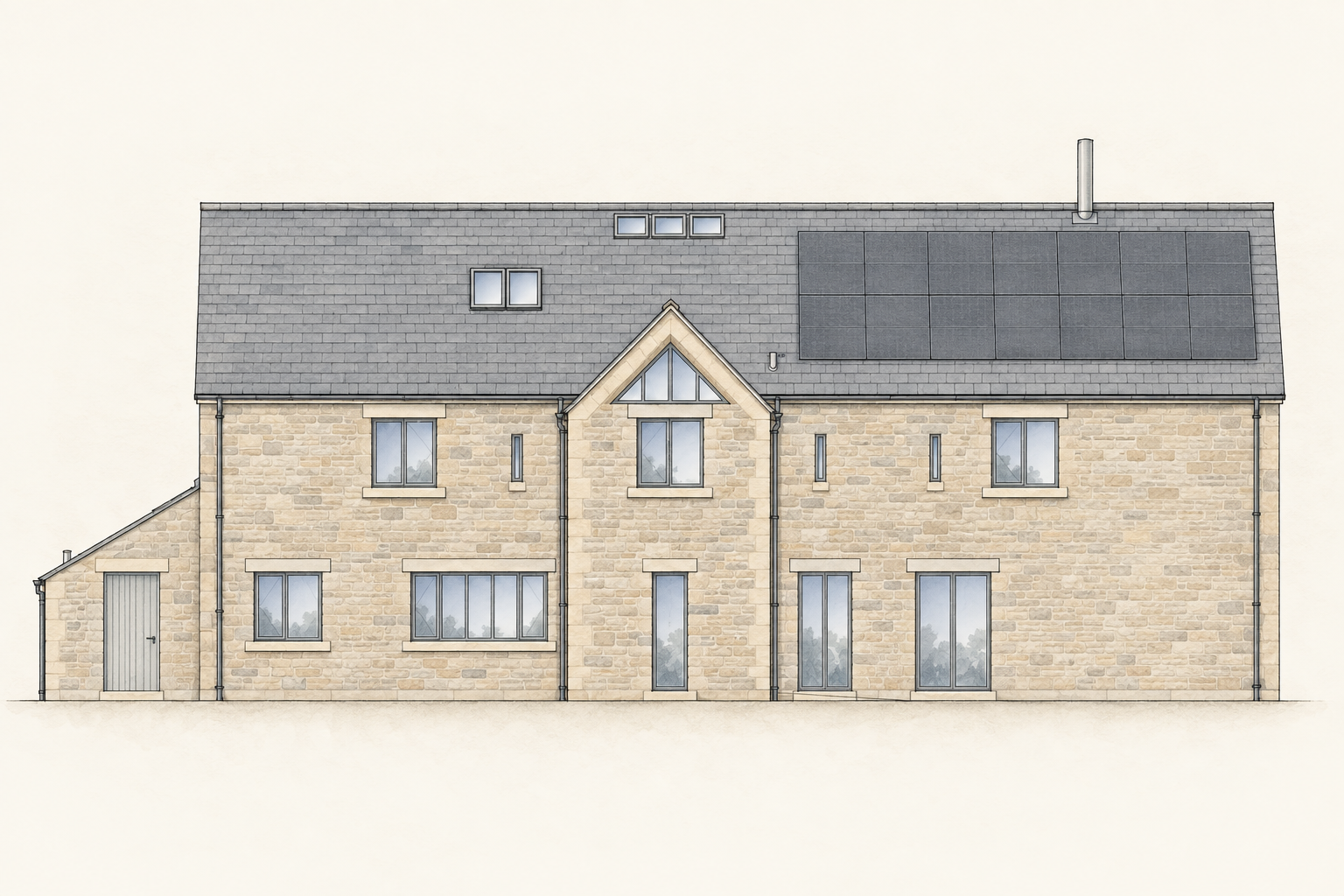
An illustration of the home we are working towards.
A self-build starts long before you start digging.
The concept of a self-build can be overwhelming, particularly to us “first-timers”. There are literally hundreds of decisions to make throughout a build. However, you do not need to make them all immediately, and we are here to help you rationalise all of the chaos into digestible actions so that you can formulate a strong strategy from the start.
Do you have to build it yourself?
No! Self-build essentially means having a home designed and built for your own use, guided by you and your preferences. You can appoint professionals to design, manage and construct it. How much you wish to take on yourself will depend on your schedule, available time, experience and budget.

Give the idea somewhere to grow.
You don’t need a plot or a set of drawings to begin exploring. Start with these four things.

Think about how you might want to live. Imagine where you and your family would gather, how you might work from home, what you need rooms for.

Consider the whole project, including land, building work, professional fees, services and money for the unexpected. Explore how you could fund it. It might help to break it down into pre-planning permission costs, and costs during construction.

A lovely setting is only the beginning. Before committing, investigate what could be built there, access, legal restrictions, services and ground conditions, with professional help where needed.

Work with suitable professionals to bring your ideas, plot and budget together. Refine the design and understand what is needed for your planning application.
These steps overlap. Learning more about a plot may change your budget or your design; getting advice early can help you see where the possibilities lie.

Before you sketch a house, finish this sentence.
“Our home would feel more like us if…”
Write down three answers. Think about small, everyday things as well as the bigger hopes. Keep the list: it is the beginning of your brief, and something to return to when the choices begin.
The reason for considering the above is because it is particularly helpful to reflect upon what you would change about your current and past homes that would make it better for the way you would like to live. For example, we wanted a large, bright kitchen with space for a dining table which connected to the outside because we spend a lot of time cooking.
Take the next steps at your own pace
Our free self-build checklist brings the early journey into eight practical stages, from your first idea to submitting a planning application in England.
Keep it beside your notes, use it to organise your questions, and return to it as your plans take shape.